G-Fin vs. Embedded Fin Tube: A Practical Comparison for Heat Exchanger Applications
G-Fin vs. Embedded Fin Tube: A Practical Comparison for Heat Exchanger Applications
Pick the wrong fin attachment for a finned tube heat exchanger and you'll be swapping tube bundles years before the spec sheet says you should. It happens. A procurement team buys on upfront cost, and two years later the fins are rattling loose under thermal load. Here's what actually separates a G fin tube from an embedded fin tube—no catalog fluff.
How a G Fin Tube Is Built
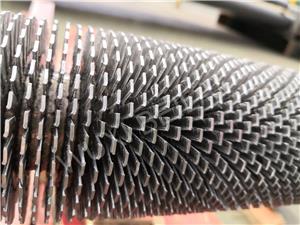
On the shop floor, a machinist cuts a continuous helical groove into the outer wall of a base tube. That groove is the anchor. An aluminum fin strip gets wound in under tension, and a roller presses the groove edges inward over the fin root. What you end up with is a mechanical lock that doesn't depend on friction or adhesive.
I've watched a G fin tube survive thermal cycles that shredded cheaper alternatives. The reason is dead simple: when the assembly heats up and the fin and tube expand at different rates, the rolled groove flexes with them rather than fighting the movement. That's a joint that breathes, not a joint that cracks. In a finned tube heat exchanger swinging between ambient and 400°C, maintenance logs tell the real story.
The Embedded Fin Tube Approach
An embedded fin tube solves the same problem from the opposite direction. Instead of a single deep groove, the tube surface gets knurled—a controlled rough texture from a rolling tool. The fin strip presses onto this surface, and those tiny displaced peaks bite into the fin base across dozens of contact points.
The grip spreads out rather than concentrating in one place. For a finned tube heat exchanger that lives under steady moderate vibration—large blowers, compressors, shipboard installations—that distribution actually helps. Because an embedded fin tube skips the extra wall thickness that grooving demands, the exchanger comes in lighter. On an offshore module where every ton costs money in structural steel, that's not a rounding error.
Where They Actually Diverge
Let's work through temperature, vibration, and corrosion—the three things that decide whether you're making the right call.
Temperature is the easiest to settle. The knurling on an embedded fin tube holds at 300°C, gets unsure at 350°C, and nobody sane pushes past that. A G fin tube with the right material pairing handles 400°C routinely; 450°C is doable. If your finned tube heat exchanger runs hotter than a textbook economizer, the answer leans one way, and it leans hard.
Vibration flips the logic. The multi-point bite of the knurled approach handles high-frequency shaking better than a single-groove lock. I've talked to maintenance leads who pulled embedded-fin bundles after eight years next to reciprocating compressors—fins still tight. Under the same conditions, the grooved joint on a G fin tube can develop micro-fretting. Not a failure, but enough to show up on inspection. Worth noting that an extruded finned tube sidesteps the vibration debate entirely—the pressure-bonded sleeve eliminates mechanical attachment as a failure mode.
Then comes corrosion, where both options hit their ceiling. Neither a G fin tube nor an embedded fin tube was built to fight chemical attack. If salt spray, acidic gases, or cooling-tower drift are in your operating environment, the extruded finned tube is your actual answer. In an extruded finned tube, an aluminum sleeve pressure-bonds over the steel core and the fins are raised from that sleeve. No interface gap for moisture. No crevice for chloride pitting. The base tube stays sealed.
For a coastal refinery, an offshore platform, or any finned tube heat exchanger exposed to the elements, an extruded finned tube sidesteps problems both mechanical-fin designs were never built to handle.
Choosing for Your Project
Temperature ceiling under 300°C, moderate vibration? Go with the embedded fin tube. Process air coolers, HVAC coils, low-pressure economizers—these are the textbook cases.
Pushing past 350°C or running aggressive duty cycles? The G fin tube earns its keep. Waste heat boilers, furnace recuperators, gas turbine exhaust recovery—the groove-and-roll lock was made for these.
Corrosion is your dominant headache? Stop looking at mechanical-fin options entirely. The extruded finned tube fundamentally changes your risk profile. Plenty of power plants run extruded finned tube bundles in moisture-exposed stages, then switch to G fin tube bundles in the dry high-temperature zones downstream—a hybrid approach within a single finned tube heat exchanger that spec sheets rarely advertise. If your entire finned tube heat exchanger faces aggressive media, the extruded finned tube is the only one of the three worth seriously evaluating.
One last point: manufacturers like Wuxi Beilai Tube Co. produce all three types—G fin tube, embedded fin tube, and extruded finned tube—under one roof. Getting thermal performance curves for all three from the same source keeps the conversation honest.
Pull your temperature logs, check your vibration surveys, read your maintenance history. Those three data points will tell you more than any catalog ever will.