How Should Coated Line Pipe Be Selected for Buried, Offshore, and Above-Ground Pipelines?
How Should Coated Line Pipe Be Selected for Buried, Offshore, and Above-Ground Pipelines?
Selecting coated line pipe requires more than choosing a corrosion-resistant coating. Buried pipelines face soil chemistry and backfilling damage, offshore pipelines encounter continuous seawater exposure and mechanical loads, while above-ground pipelines must withstand sunlight, rain, and temperature changes.
Choosing coated line pipe for buried pipeline projects, coated line pipe for offshore pipeline service, or coated line pipe for above-ground installations requires evaluating the operating medium, temperature, installation method, design life, and project specifications. A coating suitable for one environment may not provide adequate protection in another.
1. What Matters for Buried Pipelines?
Buried pipelines remain in contact with soil and groundwater for much of their service life. Soil resistivity, moisture, pH, chlorides, and microbial activity can influence external corrosion. Rocks, backfilling, and directional drilling may also damage the coating during installation.
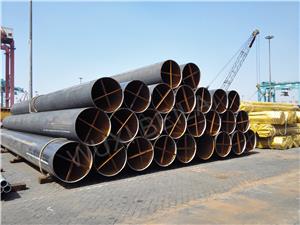
For coated line pipe for buried pipeline projects, fusion-bonded epoxy (FBE) and three-layer polyethylene (3LPE) are common options. FBE provides corrosion protection and adhesion, while 3LPE combines an epoxy primer, adhesive layer, and polyethylene outer layer to provide corrosion and mechanical protection.
The right choice depends on soil aggressiveness, operating temperature, handling conditions, and installation stresses. Coated line pipe for buried pipeline projects installed in rocky ground or by horizontal directional drilling may require additional abrasion resistance.
Buyers should also assess coating compatibility with cathodic protection. This electrical protection system helps control corrosion at coating defects, but it does not eliminate the need for an intact coating.
2. How Do Offshore Conditions Change Selection?
Subsea pipelines face seawater exposure, hydrostatic pressure, seabed movement, abrasion, and possible impact during installation. Marine growth and sediment movement can create additional maintenance challenges.
Coated line pipe for offshore pipeline service must provide durable corrosion protection while withstanding handling, laying, and long-term immersion. FBE, multilayer polyolefin systems, and other qualified subsea coating systems may be considered according to project conditions.
Some offshore pipelines also require concrete weight coating to provide negative buoyancy and additional mechanical protection. This layer serves a different purpose from the primary anticorrosion coating.
Selecting coated line pipe for offshore pipeline service therefore involves more than seawater resistance. Engineers must evaluate water depth, installation method, external loads, operating temperature, and the required service life. Cathodic protection is commonly used alongside the coating system.
3. What Changes Above Ground?
Above-ground pipelines are exposed to atmospheric corrosion, rainfall, condensation, ultraviolet radiation, and temperature fluctuations. Supports, clamps, and contact points can also create locations where moisture accumulates or coatings suffer mechanical damage.
Coated line pipe for above-ground installations needs a system suited to atmospheric exposure. Depending on the environment and specification, a coating system may use a compatible primer, an intermediate protective layer, and a UV-resistant topcoat.
Epoxy coatings can provide strong corrosion protection, but some formulations require a UV-resistant finish when exposed to direct sunlight. Coating selection should also account for operating temperature, chemical exposure, and the expected maintenance schedule.
For coated line pipe for above-ground installations, engineers should check coating performance around supports, welds, and connections, where damage or moisture retention can undermine protection.
4. Why Can't One Coating Suit Every Environment?
Coating performance depends on the interaction between the coating, steel substrate, operating conditions, and installation process.
For coated line pipe for buried pipeline projects, soil stress, moisture, impact resistance, and cathodic disbondment are important considerations. For coated line pipe for offshore pipeline service, immersion resistance, mechanical durability, and compatibility with subsea protection systems deserve particular attention.
Meanwhile, coated line pipe for above-ground installations requires appropriate resistance to weathering and UV exposure. Temperature limits also matter: a system that performs well at ambient temperature may not be suitable for a hot pipeline.
The selection process should start with the service conditions rather than a predetermined coating type. Relevant standards, manufacturer data, and project-specific qualification requirements should guide the final decision.
5. Don't Overlook Field Joints and Installation
Factory-applied coatings usually leave the pipe ends accessible for welding. After field welding and inspection, the exposed joint area must be cleaned and protected with a compatible field-joint coating.
For coated line pipe for buried pipeline projects, joint protection must withstand backfilling, soil movement, and moisture exposure. For coated line pipe for offshore pipeline service, field-joint systems must also suit the installation procedure and long-term immersion conditions.
Coated line pipe for above-ground installations requires careful treatment of welds, cut edges, supports, and repaired areas to maintain continuous protection against atmospheric corrosion.
Handling procedures matter too. Lifting equipment, transport restraints, bending, and lowering operations can damage coatings before commissioning. Holiday detection, thickness checks, adhesion testing, and visual inspection should be specified as appropriate for the selected coating system.
6. Match Coating Selection to Project Requirements
BEILAI's line pipe information identifies FBE and 3LPE among its protective coating options. Its line pipe range also references API 5L PSL1/PSL2 and ISO 3183. Buyers should confirm the available coating systems, dimensions, steel grade, and applicable requirements directly with the supplier.
For coated line pipe for buried pipeline projects, provide soil conditions, installation details, operating temperature, and cathodic protection requirements. For coated line pipe for offshore pipeline service, specify immersion conditions, mechanical protection, and any concrete weight coating requirements.
For coated line pipe for above-ground installations, clarify UV exposure, atmospheric conditions, operating temperature, and maintenance expectations. Across all three environments, the project specification should define coating thickness, surface preparation, inspection methods, repair procedures, and acceptance criteria.
Conclusion
Choosing a pipeline coating requires an integrated assessment of corrosion risks, environmental exposure, installation damage, and service life. Buried, offshore, and above-ground pipelines each present different challenges, so coating selection should follow engineering requirements rather than installation category alone.
By evaluating coated line pipe for buried pipeline projects, coated line pipe for offshore pipeline service, and coated line pipe for above-ground installations against actual operating conditions, buyers can develop a more reliable corrosion-protection strategy and reduce the risk of premature coating failure.