Which is better, extruded finned tubes or welded finned tubes? The answer depends on your operating temperature
Which is better, extruded finned tubes or welded finned tubes? The answer depends on your operating temperature
Not simply a matter of matching manufacturing methods, picking the ideal finned tube is far more complex than comparing them head-to-head.
While both an extrusal and a weld-on design boost heat transfer efficiency, these are two different methods whose results will vary according to operating conditions. The key for engineers will be understanding these differences and applying them effectively to the specific operating conditions of each project so they may both prevent unnecessary maintenance while also optimizing the performance levels of their systems.
Operating Environment Determines Performance
The question that buyers repeatedly put to us is whether an aluminum extruded finned tube or a welded finned tube performs better. From a scientific viewpoint, no single design is superior across all cases. The performance is heavily dependent on factors that include the actual operational environment where the equipment is located.
In the cases when the heat levels are average and the outdoor environment where the tube is operating, there is corrosion, aluminum extruded finned tube will more frequently deliver mechanical protection that is quite good from the fact that the aluminum sleeve entirely covers the inner tube without leaving any exposed areas that might otherwise be subjected to damage. Such a configuration prevents damage to the fins and in effect improves fin longevity.
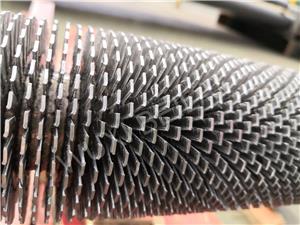
At high levels of thermal operation, a high frequency welded solid finned tube is typically the best choice. Through the welding, a metallurgical bond is established between fin and tube that is such a strong union that the whole assembly can function effectively even under extreme heat conditions.
Extruded vs Welded Finned Tubes: Performance
Heat Transfer
At the heart of every finned tube is the objective of heat transfer enhancement through an increased external surface area.
Among the possible combinations, the aluminum extruded finned tube is a great choice for those applications in which corrosion resistance, efficiency, and heat transfer capacity are equally necessary. Such examples may be industrial cooling, HVAC, and air coolers.
Welded heat exchanger fin tubes (HFWF) excel in boilers, economizers, heat recovery systems, and high temperature plants because they are able to minimize resistances at the interface due to very close bond.
Mechanical Strength
The industrial applications place mechanical durability as even a higher priority than heat transfer.
The mechanically attached fin with no gaps will provide a much improved level of fin protection of the base tube against deformation and damage for extruded tubes of aluminum. Hence, during and after the loading, the transport, assembly processes are carried out without the risk of the damaged fins for this type of design.
The continuous thermal cycling results in a strong weld connection in the high frequency welded solid finned tube which in turn is the source of enhanced fin bonding.
Such a property becomes especially valuable in plants, industrial plants, boilers, etc. for which the heating is done in cycles, thus the equipment is subjected to heating and cooling repeatedly.
Corrosion Resistance
Usually, the material choice is influenced more by corrosion condition rather than by temperature if we look into this factor.
When the air contains high levels of moisture or contaminants that may promote rusting, the aluminum extruded finned tube is the best way to protect the inner metal pipe from external corrosion and also maintain a high level of heat transfer efficiency.
To meet the challenge of corrosion caused by an aggressive process media or due to high temperatures in a working condition, one may prefer selecting stainless steel or alloy base of the products of high frequency welded solid finned tube that will give a balance of corrosion resistance and mechanical strength through proper choice of materials.
Selecting the Wrong Finned Tube Is a Common Error
Assume that one fitted the same finned tube in a fin tube heat exchanger of every unit regardless of their different thermal conditions. It is a mistake as the performance of the heat exchanger units (fin tube heat exchanger) like coolers, boilers, economizers, condensers as well as waste heat recovery units is different because the thermodynamic boundary conditions of each device are distinctive.
Maintenance needs should also be considered when making any purchase decision. The aluminum extruded finned tubes are quite good in different outdoor locations but high frequency welded solid finned tubes can have a much longer life in systems that operate continuously at high temperatures.
The results of overlooking the real conditions of the operating situation usually are extra costs for maintenance, the deterioration of efficiency of equipment, or both.
The Selection Process for Engineers
As an engineer, I normally have to check four different criteria in order to find out which finned tube will be most suitable.
Operating temperature is always my first concern. A finned unit based on low temperature is more likely to be an aluminum extruded finned tube but a finned unit subjected to long hours at high temperatures will usually be a high frequency welded solid finned tube.
Working Pressure will be the next factor. While the pressure mainly refers to the base tube, indirectly it would still have an effect on the overall reliability of a finned tube heat exchanger.
Third is, the type of process medium, whether it involves a corrosive gas or a gas containing water or sulfur or a vapor that will have a considerable effect on a material’s choice.
Lastly, the planned level of maintaining the equipment should be evaluated. If one wants a plant running for several tens of years, there is merit in spending a great deal in the initial capital if in so doing, maintenance shutdowns as well as replacement costs of the equipment can be minimized.
Quality of Manufacturing
Even the right fin and base tube combination cannot overcome a faulty process of manufacturing.&160;
BEILAI ensures that all finned tubes pass through various levels of strict quality management starting from the raw material verification, fin forming, welding, dimensional inspection, performance testing, etc.
By ensuring the production quality, BEILAI helps every aluminum extruded finned tube maintain superb fin integrity & mechanical stability.
In the case of the high frequency welded solid finned tubes used for challenging industrial applications, the welded part is controlled precisely during manufacturing to ensure that the strong and durable bond between fin and tube is the result.
Closing Thoughts
There is no absolute answer to which of the two technologies gives better results: the extruded or the finned tube.
The use of an aluminum extruded finned tube often results in long life of mechanical parts in corrosion-prone environments for cooling systems. For thermal applications subjected to very hot temperatures, it is usually the high frequency welded solid finned tube that is capable of the most reliable performance.
By making an evaluation of the whole operating situation rather than focusing on a single aspect only, engineers will be able to choose the best finned tube type and thus maintain their plants not only efficiently but also reliably in the long run.