Choosing Between Embedded Finned Tube and Welded Finned Tube: What Really Matters for Your Heat Exchanger
Choosing Between Embedded Finned Tube and Welded Finned Tube: What Really Matters for Your Heat Exchanger
In industrial heat exchange equipment, the finned tube is not just a small component—it is the core element that determines how efficiently energy moves through a system. At BEILAI, we have spent decades manufacturing and optimizing advanced heat transfer products, and we understand that choosing the right finned tube structure directly influences system efficiency, service life, and maintenance costs.
Among all fin designs used today, the comparison between the embedded finned tube and the welded finned tube is one of the most discussed topics in thermal engineering. Both belong to the family of high-performance finned tube technology, yet they offer different advantages depending on the application environment. This article explores these differences in a clear, human-centered way while showing how BEILAI’s engineering experience helps customers make the right decision.
Understanding the Structure of Embedded vs. Welded Fins
Before comparing performance, it is important to understand how each type is made.
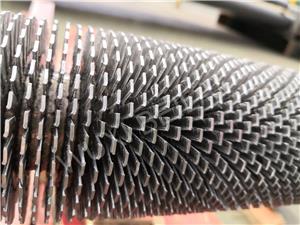
The embedded finned tube is manufactured by mechanically inserting a fin into a precisely machined groove on the tube surface. After embedding, the fin is expanded or pressed tightly to create strong mechanical bonding. This method naturally improves thermal contact and ensures the fin will not loosen even under long-term temperature cycling.
Meanwhile, the welded finned tube uses high-frequency welding or solid resistance welding to fuse the fin directly onto the tube surface. This process forms a continuous metallurgical bond, giving the welded finned tube excellent structural strength and stability at high temperatures.
Both technologies are part of BEILAI’s portfolio of high-performance finned tube technology, and the choice largely depends on heat flow conditions, working temperatures, and corrosive exposure.
Advantages of Embedded Finned Tubes in Moderate-Temperature Applications
The embedded finned tube has long been favored in many air-cooled heat exchangers, HVAC systems, and various gas-to-fluid applications. One major advantage is its exceptional thermal contact. The mechanical insertion forces a tight interface between the fin and base tube, enabling excellent heat conduction.
In addition, the embedded finned tube offers extremely good resistance against fin loosening, even during continuous thermal cycling. For systems with frequent temperature fluctuations, this stability contributes significantly to long-term performance.
Because of its efficient thermal path, an embedded finned tube is often the optimal choice when industries aim for a balance of efficiency, cost, and durability. Its suitability for moderate-temperature environments makes it one of the most widely adopted solutions in high-performance finned tube technology.
Why Welded Finned Tubes Excel in Harsh, High-Temperature Conditions
On the other hand, the welded finned tube delivers superior performance in environments involving extreme heat, high vibration, or corrosive atmospheres. The welding process forms a strong, continuous bond, greatly improving the mechanical strength of the fin joint.
This makes the welded finned tube a preferred option for boilers, petrochemical heaters, refinery air coolers, and process heat exchangers where temperatures can rise dramatically.
Another advantage of the welded finned tube is its robustness under abrasive or corrosive gas flows. Since the fin is welded directly to the tube wall, erosion damage tends to progress more slowly. For customers who require maximum service life and minimal downtime, BEILAI recommends the welded finned tube as part of its premium high-performance finned tube technology product series.
Comparing Heat Transfer Performance in Real Applications
While both fin types enhance the external surface area of the tube, how they conduct heat differs slightly.
The embedded finned tube often offers better initial heat transfer because of its tight mechanical contact and optimized groove design. It is common in air-cooled units, chillers, and moderate-temperature industrial coolers.
Conversely, the welded finned tube maintains stable performance even when thermal loads become extreme. With metallurgical bonding, the fin remains highly efficient throughout long service cycles, making it ideal for high-pressure or high-temperature systems.
At BEILAI, we produce both styles according to international standards and customer specifications. Our engineers evaluate the thermal performance, temperature environment, and long-term durability demands before recommending either an embedded finned tube or a welded finned tube solution.
Material Flexibility and Customization at BEILAI
The success of any finned tube design depends not only on the fin type but also on the material choice. BEILAI manufactures embedded finned tube and welded finned tube products using carbon steel, stainless steel, alloy steel, copper, copper-nickel, and aluminum.
This material diversity allows us to deliver high-performance finned tube technology tailored for the power industry, petrochemical processing, waste heat recovery, and specialized cooling systems.
Every finned tube produced at BEILAI undergoes strict checks for fin adhesion, bonding performance, dimensional accuracy, and corrosion resistance.
How BEILAI Helps Customers Select the Right Finned Tube Design
Choosing between an embedded finned tube and a welded finned tube is not always straightforward. Customers often need to match thermal efficiency requirements, pressure levels, environmental challenges, and operational cost expectations.
BEILAI provides engineering assistance to help operators compare system loads, analyze gas composition, predict thermal cycles, and estimate long-term maintenance conditions. With decades of accumulated expertise in high-performance finned tube technology, our team focuses on optimizing both performance and reliability.
Conclusion: Two Technologies, One Goal—Better Heat Transfer
Both the embedded finned tube and the welded finned tube play critical roles in industrial heat exchangers. Each type excels in different environments but shares the same purpose: delivering stable, efficient, and long-lasting heat transfer performance.
At BEILAI, our mission is to provide customers with high-performance finned tube technology that meets the evolving challenges of modern industries. Whether your application calls for an embedded finned tube for moderate temperatures or a welded finned tube for extreme conditions, BEILAI offers trusted quality, engineered precision, and long-term reliability.