Finned Tube Solutions for High-Efficiency Industrial Heat Transfer
Finned Tube Solutions for High-Efficiency Industrial Heat Transfer
Introduction
In real industrial environments, heat transfer efficiency is rarely a theoretical problem. Engineers deal with limited installation space, rising energy costs, and strict operating reliability requirements. This is where the finned tube becomes a practical solution rather than a design preference. By increasing the external heat exchange area without enlarging the system footprint, a finned tube helps equipment maintain thermal performance under demanding conditions.
At BEILAI, long-term involvement in power, refinery, and heat recovery projects proves one thing clearly: a finned tube only delivers value when material selection, welding quality, and application matching work together. Numbers on a datasheet alone never guarantee performance.
Application Scenarios: Where Finned Tubes Are Used
Engineers commonly specify a finned tube in air coolers, waste heat recovery units, boilers, and industrial heat exchangers. In air-cooled systems, heat exchanger tubing with fins compensates for the low heat transfer coefficient on the air side, allowing compact layouts without sacrificing capacity.
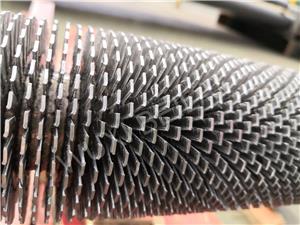
In energy-intensive industries, high efficiency heat transfer tubes support continuous operation by stabilizing outlet temperatures and reducing fuel consumption. Exhaust gas recovery systems often rely on spiral finned tubes for heat exchangers to handle large temperature differences while maintaining mechanical integrity.
Across these applications, the finned tube acts as a bridge between thermal efficiency and structural reliability.
Key Pain Points from the Buyer's Perspective
From a buyer's standpoint, selecting a finned tube often comes with uncertainty. Many suppliers promise performance, but operational issues usually appear after installation. One common pain point involves weak bonding between fin and base tube. When heat exchanger tubing with fins suffers from poor welding, thermal resistance increases over time.
Another concern relates to vibration and fatigue. Improperly designed spiral finned tubes for heat exchangers may crack under continuous airflow or thermal cycling. Buyers also question whether high efficiency heat transfer tubes truly deliver measurable energy savings in real conditions, not just simulations.
These issues highlight why experience and process control matter more than marketing language.
Selection Criteria That Truly Matter
When choosing a finned tube, experienced buyers focus on factors that directly affect service life. Material compatibility comes first. Carbon steel, alloy steel, or stainless steel must match the operating temperature and corrosion environment, especially for heat exchanger tubing with fins exposed to flue gas or moist air.
Fin geometry plays a critical role. Spiral finned tubes for heat exchangers offer continuous contact and uniform heat flow, making them suitable for high-duty systems. Welding technology also matters. High-frequency welding ensures tight bonding, which helps high efficiency heat transfer tubes maintain stable thermal performance.
A reliable finned tube design balances thermal gain with mechanical strength, not one at the expense of the other.
Parameter Recommendations Based on Project Practice
In real projects, oversizing often creates more problems than benefits. For a finned tube, fin height, thickness, and pitch must match airflow velocity and fouling risk. Excessively dense fins may reduce airflow efficiency, even in high efficiency heat transfer tubes.
Wall thickness selection must consider pressure and thermal stress, especially in spiral finned tubes for heat exchangers used in boilers and waste heat systems. For heat exchanger tubing with fins, dimensional consistency improves tube bundle assembly and ensures even heat distribution.
At BEILAI, every finned tube undergoes dimensional inspection and weld integrity checks to keep large-batch production consistent with design intent.
Common Mistakes That Reduce Performance
One frequent mistake is treating all finned tube products as interchangeable. In practice, heat exchanger tubing with fins designed for air coolers performs very differently from tubes used in high-temperature recovery systems. Another error involves prioritizing fin quantity over weld quality.
Without proper bonding, high efficiency heat transfer tubes lose effectiveness long before the end of their design life. Buyers also overlook long-term maintenance. Spiral finned tubes for heat exchangers require appropriate spacing to allow cleaning and inspection.
Avoiding these mistakes starts with understanding how the finned tube will operate over years, not just during commissioning.
Conclusion
A finned tube is more than a heat transfer enhancement—it is a long-term performance component. When engineers select the right materials, fin structure, and welding process, heat exchanger tubing with fins delivers consistent thermal efficiency and mechanical reliability. For demanding industrial systems, high efficiency heat transfer tubes reduce energy waste and stabilize operation. In applications requiring durability and high heat flux, spiral finned tubes for heat exchangers remain a proven and dependable solution.