Why Are Pipe Connections Critical in Cold Service Industrial Piping Systems?
Why Are Pipe Connections Critical in Cold Service Industrial Piping Systems?
Industrial cooling and low-temperature piping systems experience repeated temperature changes during startup, shutdown, and load adjustments. These changes cause pipes and connected components to expand or contract, creating additional stress around flanges, welds, valves, and supports.
For cold service industrial piping during startup cycles, the main concern is not simply reaching a low operating temperature. Repeated thermal movement can gradually affect connection integrity and increase the risk of leakage or fatigue damage. Proper cold service industrial piping connection design must therefore consider the full operating temperature range and the system's cold service industrial piping minimum design temperature.
1. Why Do Temperature Changes Affect Pipe Connections?
Steel contracts when cooled and expands when heated. When a piping system moves between ambient temperature and cold operating conditions, its dimensions change. If the pipe can move freely, this movement may be manageable. However, anchors, supports, equipment nozzles, and connected components can restrict movement.
During cold service industrial piping during startup cycles, different sections may cool at different rates. This creates temperature gradients and uneven contraction along the pipeline. The resulting forces can act on flanges, welded joints, and equipment connections.
A reliable cold service industrial piping connection design should account for these movements instead of treating connections as isolated components. Engineers also need to evaluate the cold service industrial piping minimum design temperature, because material suitability and component requirements depend on the lowest expected temperature.
2. How Do Startup and Shutdown Cycles Create Stress?
During startup, cold fluid enters piping that may initially be near ambient temperature. The pipe wall cools, contracts, and transfers loads to connected components. During shutdown, the temperature may rise again, reversing the movement.
Repeated cold service industrial piping during startup cycles can create several problems:
· Flange faces may experience uneven movement, affecting gasket compression.
· Welded connections may experience cyclic thermal stress.
· Bolts and connected components may experience changing loads.
· Supports and anchors may restrict contraction.
· Different cooling rates may create local temperature gradients.
The number and severity of operating cycles matter. A system that experiences frequent starts and stops may accumulate fatigue damage faster than one operating continuously under stable conditions.
Engineers should therefore include cold service industrial piping during startup cycles in their stress analysis and operating assessments. The cold service industrial piping connection design should also consider how thermal movement affects valves, pumps, and other connected equipment.
3. Why Do Flanges and Welded Joints Need Special Attention?
Connections are often more sensitive to thermal movement than straight pipe sections because they contain geometric transitions, restraints, and multiple components.
Flanged joints depend on sufficient and reasonably uniform gasket compression. Differential contraction between the pipe, flange, bolts, and gasket can change the contact pressure. If the joint experiences excessive movement or uneven loading, leakage may occur.
Welded connections avoid gasket-related leakage paths, but they still experience thermal stress. Poor alignment, residual welding stress, and local temperature gradients can increase the risk of fatigue cracking.
For cold service industrial piping connection design, engineers should verify flange ratings, gasket compatibility, bolt materials, welding procedures, and the expected thermal movement. They should also evaluate connected equipment loads rather than checking the pipe alone.
During cold service industrial piping during startup cycles, controlled cooling rates can help reduce severe temperature differences between connected sections.
4. Why Is Minimum Design Temperature More Important Than Normal Temperature?
Normal operating temperature does not always represent the most demanding condition. Startup, emergency depressurization, process upset, or unexpected cooling may expose components to temperatures below their usual operating range.
The cold service industrial piping minimum design temperature should represent the lowest component temperature expected under the defined design conditions. It may determine material selection, impact-test requirements, and component qualification.
ASTM A333/A333M covers seamless and welded steel pipe intended for low-temperature service and applications requiring notch toughness. Its requirements include specified mechanical and impact testing. Different grades have different impact-test temperatures, so buyers must select according to the project specification rather than assume every grade provides the same performance.
For cold service industrial piping minimum design temperature, engineers should also check fittings, flanges, valves, bolting, and other pressure-containing components. Selecting suitable pipe while overlooking connected components can leave weak points in the system.
5. How Does Thermal Cycling Affect Long-Term Reliability?
Repeated expansion and contraction can produce cyclic stresses. When these stresses occur frequently, fatigue may develop around weld toes, branch connections, supports, and other areas of stress concentration.
A sound cold service industrial piping connection design should consider the number of expected cycles, temperature range, restraint conditions, and flexibility of the piping layout.
Engineers can reduce excessive thermal loads through suitable routing, expansion flexibility, correctly positioned supports, and appropriate anchor arrangements. Stress analysis should account for thermal loads caused by restrained expansion and contraction, as well as fatigue from repeated thermal cycling.
ASME B31.3 identifies thermal expansion and contraction effects, temperature gradients, and cyclic loading as considerations in piping design.
For cold service industrial piping during startup cycles, operating procedures are also important. Controlled startup, gradual cooldown, and monitoring of abnormal vibration or leakage can help reduce operating risks.
6. Match Pipe Materials to Actual Service Conditions
Connection reliability depends partly on the pipe material's ability to maintain adequate toughness at low temperatures. A material suitable for ambient-temperature service may not be appropriate for a system exposed to substantially lower temperatures.
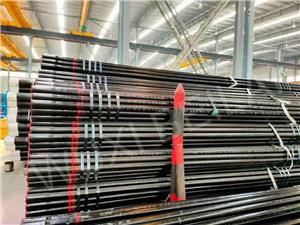
BEILAI's ASTM A333 low-temperature pipe range includes Grades 1, 3, 4, 6, 7, 8, 9, 10, and 11. The product information lists sizes from 1/8 inch to 24 inches, multiple wall thickness schedules, and impact-test temperatures extending to -195°C for selected grades.
When specifying cold service industrial piping minimum design temperature, buyers should confirm the required grade, impact-test temperature, dimensions, and applicable standard. They should also ensure that fittings and connection components meet compatible low-temperature requirements.
For cold service industrial piping connection design, material compatibility across the complete piping assembly is essential. A suitable pipe grade cannot compensate for an incorrectly specified flange, gasket, or bolt.
Conclusion
Pipe connections are critical because thermal contraction and expansion transfer loads throughout a piping system. Repeated startup and shutdown cycles can affect flange sealing, welded joints, supports, and connected equipment.
Reliable cold service industrial piping during startup cycles requires attention to operating procedures, thermal stress, and fatigue. A suitable cold service industrial piping connection design must accommodate movement, while the cold service industrial piping minimum design temperature should guide material selection and component qualification.
Considering these factors during engineering and procurement helps reduce leakage risks and improve the long-term reliability of industrial low-temperature piping systems.