How Cryogenic Service Steel Piping Handles Thermal Contraction in Low-Temperature Systems
How Cryogenic Service Steel Piping Handles Thermal Contraction in Low-Temperature Systems
When a pipeline carries a cryogenic fluid, the steel does not simply become colder. Its dimensions also change. A long section of pipe can contract as its temperature falls, creating movement that must be absorbed by the piping system.
This is why subzero temperature steel pipe thermal contraction needs to be considered during both material selection and pipeline design. A pipe may have adequate low-temperature toughness but still experience excessive thermal stress if the system prevents it from moving.
For subzero temperature steel pipe for cryogenic systems, engineers therefore need to consider material behavior, pipe length, temperature difference, supports, spacing, bends, and expansion loops as one connected design problem.
Why Does Steel Pipe Contract at Low Temperature?
Like most metals, steel changes size when its temperature changes. When temperature decreases, the pipe generally contracts. The amount of movement depends on the material's coefficient of thermal expansion and the temperature difference.
The basic relationship can be expressed as:
ΔL = α × L × ΔT
where ΔL is the change in length, α is the coefficient of thermal expansion, L is the original pipe length, and ΔT is the temperature change.
For a short pipe section, this movement may be relatively small. Across a long pipeline, however, the accumulated displacement can become significant.
This makes subzero temperature steel pipe thermal contraction an important design consideration for LNG, cryogenic gas, refrigeration, and other cold-service systems.
A subzero temperature steel pipe for cryogenic systems must therefore be considered as part of a complete piping arrangement rather than as an isolated steel component.
How Does Contraction Affect Long Pipelines?
The longer the pipe, the greater the potential dimensional movement for the same temperature change.
Imagine a long straight pipeline installed at ambient temperature and then exposed to a very cold operating medium. The pipe attempts to shorten as its temperature falls.
If the pipe can move freely, much of the thermal movement can be accommodated through displacement.
If the pipe is tightly restrained, however, the movement cannot occur freely. The restraint creates forces and stresses in the pipe and at connected equipment.
This is where subzero temperature steel pipe thermal contraction becomes a system-level issue.
For subzero temperature steel pipe for cryogenic systems, engineers need to evaluate:
Operating temperature
Installation temperature
Pipe length
Material properties
Anchor locations
Support arrangement
Direction of movement
Equipment connections
Bends and flexible sections
The longer the pipeline and the larger the temperature difference, the more carefully the movement needs to be managed.
How Does Thermal Contraction Create Pipe Stress?
Thermal movement itself is not necessarily a problem. The difficulty appears when the piping system restricts that movement.
A freely contracting pipe can shorten. A restrained pipe cannot shorten as easily, so thermal displacement is converted into stress and reaction forces.
This is a central issue in subzero temperature steel pipe thermal contraction design.
For example, fixed anchors can prevent movement in one direction. Guides can control lateral movement while allowing axial displacement. Poorly positioned supports can introduce unwanted loads into the pipe or connected equipment.
In subzero temperature steel pipe for cryogenic systems, engineers therefore need to distinguish between:
Pipe movement
Pipe stress
Support reaction
Anchor loads
Equipment nozzle loads
The design objective is not to eliminate movement. It is to control where that movement occurs and how the resulting forces are distributed.
What Do Expansion Loops and Supports Do?
Expansion loops provide additional flexibility within the piping system.
Instead of forcing a long straight pipe to absorb all thermal movement, a loop or properly arranged bend gives the pipe a controlled path for displacement.
This can reduce the forces transferred to anchors and connected equipment.
For subzero temperature steel pipe thermal contraction, the location and geometry of these flexible sections matter. A loop that is too small may not provide sufficient flexibility, while an unsuitable support arrangement can restrict the intended movement.
Supports also need to be positioned according to the piping design.
Common functions include:
Carrying pipe weight
Controlling vertical movement
Guiding horizontal movement
Maintaining pipe alignment
Limiting excessive displacement
Transferring loads to structural supports
For subzero temperature steel pipe for cryogenic systems, support spacing must therefore be considered together with thermal movement rather than treated only as a structural calculation.
Why Does Pipe Spacing Matter?
Pipe spacing affects more than installation convenience.
When a cold pipeline contracts, its position can change relative to neighboring pipes, structures, valves, insulation systems, and equipment.
If adjacent components are installed too closely, thermal movement can create interference.
For subzero temperature steel pipe thermal contraction, engineers should leave sufficient clearance for expected movement and insulation thickness. The arrangement should also allow access to valves, flanges, supports, and inspection points.
In subzero temperature steel pipe for cryogenic systems, this becomes particularly important around bends, anchors, expansion loops, and equipment connections.
Why Must Material and Design Be Considered Together?
Selecting a low-temperature pipe is only one part of the engineering solution.
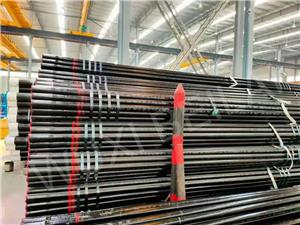
BEILAI's low-temperature pipe range includes ASTM A333 products in sizes from 1/8" to 24", with multiple wall-thickness schedules and grades. The listed impact-test temperatures vary by grade, including Grade 6 at −50°F (−45°C) and Grade 8 at −320°F (−195°C).
These requirements address low-temperature material performance, particularly toughness. They do not eliminate the need to design for thermal movement.
That distinction is important. Subzero temperature steel pipe thermal contraction is a mechanical design issue, while low-temperature toughness is a material-performance issue. A reliable system needs both.
For subzero temperature steel pipe for cryogenic systems, engineers should therefore evaluate:
Minimum design temperature
Impact-test requirements
Pipe dimensions
Thermal contraction
Support conditions
Anchor loads
Flexibility
Welding and connections
What Should Engineers Check Before Finalizing the Design?
A practical design review for subzero temperature steel pipe thermal contraction should begin with the actual temperature profile rather than simply the nominal pipe size.
Check:
Installation temperature
Minimum operating temperature
Expected temperature difference
Pipeline length
Material grade
Wall thickness
Anchor locations
Support spacing
Expansion loops or flexible bends
Clearance around adjacent equipment
For subzero temperature steel pipe for cryogenic systems, the pipe specification and piping layout should be reviewed together.
The key engineering principle is straightforward: the pipe will contract, so the system needs a controlled way to accommodate that movement.
Engineering Takeaway
Low-temperature pipeline design is not only about selecting steel that remains tough in cold service. Subzero temperature steel pipe thermal contraction can create substantial displacement across long runs, and restrained movement can generate significant forces at supports, anchors, bends, and equipment connections.
A properly designed subzero temperature steel pipe for cryogenic systems combines suitable low-temperature material properties with adequate flexibility and controlled movement.
Expansion loops, correctly positioned supports, appropriate spacing, and careful anchor design give the pipe somewhere to move when temperatures fall. Material selection then provides the toughness and mechanical performance needed for the actual service temperature.
For cryogenic and subzero piping, the most reliable approach is to design the pipe and the movement path as one system.